

You’ve got stable income, solid career trajectory, and maybe even a healthy brokerage account—but Seattle’s down payment math still feels like a gatekeeper. That’s why “first-time buyer” isn’t just a label here; it’s a set of tools that can change what you can afford, how fast you can compete, and how much cash you need to keep liquid.
Below is a practical, Seattle-specific walkthrough of first time homebuyer programs Seattle buyers tend to use (and the common missteps that derail them). The goal is simple: help you decide which programs actually fit your numbers and your timeline, without pretending there’s one perfect option for everyone.
How “first-time homebuyer” is defined in Seattle
Most programs don’t require you to have never owned a home. Many define a first-time homebuyer as someone who hasn’t owned a primary residence in the last three years. That matters if you owned years ago, got divorced, or bought a condo out of state and have been renting in Seattle since.
A second nuance: eligibility often depends on whether the new home will be your primary residence, your household income, and the price of the home relative to local limits. In King County, those limits can be surprisingly high compared to other parts of the country, but they still exist—and the home you want might sit just above them.
The program “stack” most Seattle buyers should consider
When buyers say “program,” they often mean one of three things: a loan type (FHA, VA, conventional), down payment assistance (DPA), or a special conventional option like HomeReady/Home Possible. In practice, you’re usually building a stack: the base mortgage plus a down payment strategy plus a plan for reserves and closing costs.
If you’re trying to compete in a multiple-offer neighborhood—Ballard, Greenwood, West Seattle, parts of Bellevue—the right stack is the one that’s financeable and seller-friendly. Sometimes the lowest down payment isn’t the best move if it makes your offer weaker or increases monthly payment risk.
First time homebuyer programs Seattle buyers use most
Seattle-area first-time buyers generally land in one of these lanes.
FHA loans (3.5% down): flexible, but not always “Seattle-competitive”
FHA is often the entry point because it allows a 3.5% down payment and can be more forgiving on credit scores and debt-to-income ratios than some conventional paths.
The trade-off is monthly mortgage insurance (which can be costly), plus appraisal and property-condition standards that can complicate older housing stock—common in Seattle. If you’re offering on a home that needs work, or you’re up against a conventional buyer putting 10–20% down, FHA can be less competitive.
Where FHA can shine: condos that meet standards, homes priced comfortably within FHA loan limits, and buyers who need a more flexible credit box to get in the game.
VA loans (0% down): one of the strongest options when used well
If you’re eligible, VA is a powerful program in this market: zero down payment, no monthly mortgage insurance, and often great rates.
The nuance is execution. VA is not “weak” financing, but the details matter—clean documentation, tight timelines, and an experienced team that understands Seattle contract norms. You can also choose to put money down, which sometimes helps with appraisal gaps or monthly payment targets.
Where VA can shine: competitive offers where cash preservation matters, buyers who want to keep funds invested or available for reserves, and buyers purchasing in higher-cost areas where mortgage insurance would otherwise be a large monthly expense.
Conventional 3% down (HomeReady/Home Possible): great fit for many W-2 buyers
For buyers with good credit and stable income, 3% down conventional options can be a sweet spot. HomeReady (Fannie Mae) and Home Possible (Freddie Mac) are designed for low-to-moderate income households and allow reduced down payments with more flexible sources of funds.
These programs typically come with income limits and homebuyer education requirements. In Seattle, some tech buyers assume they’re automatically over the limit, but “household income” rules and household size can create surprises—sometimes positive, sometimes not.
Where these can shine: buyers with strong credit who want a conventional offer (often more seller-friendly than FHA), and households that fit under the program’s income cap.
Standard conventional (5–20% down): the “cleanest” offer, but cash-heavy
A plain conventional loan with 5–20% down is often the most straightforward from a seller’s perspective. The appraisal and condition requirements are generally less strict than FHA, and you have flexibility on mortgage insurance (including ways to reduce or avoid it).
The trade-off is liquidity. A common Seattle mistake is draining cash to hit a round down payment number and then feeling squeezed by closing costs, prepaid items, reserves, and the reality of moving into a house that needs immediate spending.
Where it shines: buyers who want maximum offer strength and have enough cash to stay comfortable after closing.
Down payment assistance (DPA): helpful, but it depends on your income and timeline
Down payment assistance can be a real bridge for first-time buyers, especially if your income is solid but you haven’t had time to accumulate a large down payment while paying Seattle rent.
Most DPA programs come with rules: income limits, purchase price limits, required education courses, and sometimes “silent second” loans that must be repaid when you sell or refinance. Some are grants; many are deferred-payment loans.
The biggest practical consideration in Seattle is speed and certainty. Some DPA programs add steps and extra approvals. In a hot market, that doesn’t mean “don’t use them”—it means you should get fully underwritten early and make sure your offer terms match the program’s realities.
If you’re a tech professional with variable compensation (RSUs, bonuses, commission), DPA eligibility can be tricky. Some programs look at current income in a way that counts bonuses; others focus on stable base. This is one of those “it depends” moments where you want the numbers reviewed before you set your home search expectations.
Seattle-specific affordability help: what to watch for
Seattle and Washington State have housing affordability programs that may support first-time buyers through education, favorable terms, or assistance. The catch is that program availability, funding cycles, and guidelines can change. Even within the same year, you can see updates in income thresholds, interest rate structures, or which lenders are approved to offer a program.
Instead of chasing a program name you heard from a coworker, focus on the characteristics that drive eligibility:
- Income limits (often based on area median income and household size)
- Purchase price caps (which can matter quickly in Seattle)
- Occupancy rules (almost always primary residence)
- Homebuyer education requirements
If you check those boxes, the program can be worth pursuing. If you miss one—especially purchase price—it’s better to know early and switch strategies than to fall in love with a home that forces a last-minute financing pivot.
The “real” cost hurdle: cash to close vs. monthly payment
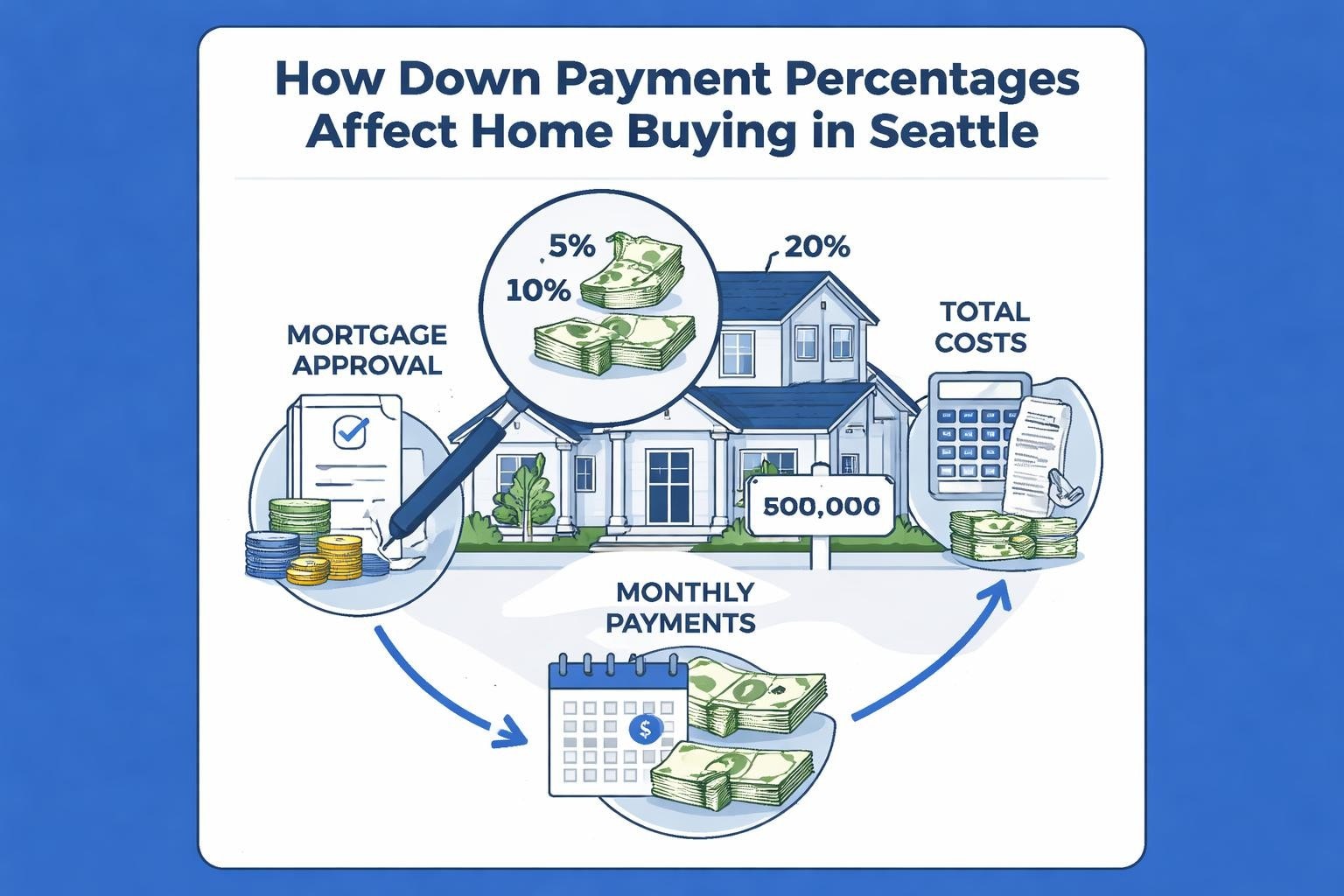
Seattle buyers often fixate on down payment percentage, but the decision is usually about two separate constraints: cash to close and monthly payment comfort.
With higher interest rates or higher HOA dues (common with condos), a low down payment can create a monthly payment that doesn’t match your lifestyle—even if you technically qualify. On the other hand, pushing down payment too high can leave you without reserves, which is risky in a city where a simple repair can cost more than expected.
A smart plan balances:
- enough down payment to make the offer competitive and the payment manageable
n- enough reserves to handle repairs, life changes, or a temporary income shift
That balance looks different for a buyer with steady W-2 income than for someone whose compensation leans heavily on RSU vesting schedules.
A quick, realistic example (tech compensation included)
A common Seattle scenario: a buyer at a major tech company has strong base pay but also meaningful RSUs. They have money in investments, but they don’t want to liquidate at the wrong time or trigger tax consequences.
In that case, the “best” first-time buyer approach may not be the smallest down payment available. It might be a conventional option that keeps the offer clean, while using a structured plan for reserves and documenting vesting income properly. The key is choosing a program that aligns with how underwriters count income and how quickly you need to close.
This is where working with a broker who understands Seattle comps and tech income can shorten the path from “pre-approval” to “keys,” because the paperwork strategy is part of the competitiveness strategy.
Common mistakes I see with first-time buyers in Seattle
The biggest issues aren’t about motivation; they’re about timing and assumptions.
First, buyers often wait to learn program rules until after they’re already shopping. In Seattle, that can lead to writing offers that don’t fit the financing path—then scrambling.
Second, many buyers underestimate closing costs and prepaid items. Even with down payment help, you need a plan for the rest of the cash to close.
Third, people treat “pre-approval” as a finish line. In a competitive market, a stronger move is getting fully underwritten early so sellers and listing agents see less risk.
How to choose among first time homebuyer programs Seattle options
Start by being honest about your constraint: is it cash to close, monthly payment, offer competitiveness, or qualifying based on income documentation?
If cash is tight but income is stable, you’ll likely explore 3% down conventional options and DPA. If you’re eligible for VA, it should be on the table early. If credit needs time, FHA can be a strong stepping stone, but you’ll want to be strategic about which homes you pursue.
And if your income includes RSUs or bonuses, don’t assume the program that worked for a friend will work for you. The details of how income is counted can change what you qualify for—and how smooth the closing feels.
If you want a straightforward, Seattle-local review of which lane fits your situation, The Mortgage Reel is a good place to start: https://Www.themortgagereel.com.
A helpful closing thought: the best first-time buyer plan in Seattle isn’t the one with the flashiest headline—it’s the one that lets you write an offer with confidence and still sleep well after you move in.