Is it a good time to buy a house in Seattle 2026?
Last Updated: April 2026 | Reading Time: ~9 minutes
It’s one of the most searched questions in Seattle real estate right now — and it deserves an honest, data-driven answer rather than a sales pitch.
The short version: for buyers who are financially prepared, 2026 offers a market window that hasn’t existed in several years. More inventory, less frenzied competition, stabilizing prices, and improving affordability math compared to the 2022–2023 peak. That doesn’t make Seattle “affordable” by any national standard — the median home price is still around $850,000 — but it does make the decision clearer and less panicked than it’s been in a long time.
Here’s a balanced, honest look at the factors that matter.
What the Seattle Market Actually Looks Like Right Now
Before answering whether it’s a good time to buy, let’s establish what’s actually happening in the market as of April 2026.
Prices: The median sale price in Seattle is approximately $850,000, essentially flat — down just 0.35% year-over-year according to Redfin. This is not a crash. Home prices have shown remarkable resilience even as the volume of sales has slowed. Seattle’s strong tech employment base and supply constraints continue to put a floor under values.
Inventory: Active listings in King County have nearly doubled year-over-year, reaching approximately 2,933 homes in early 2026. This is meaningfully more supply than buyers have seen in years — not abundant, but far more than the near-empty shelves of 2021–2022.
Days on market: Homes are selling in around 21–24 days on average — up from 10–11 days a year ago. This gives buyers time to make thoughtful decisions rather than offering sight-unseen within hours of listing.
Competition: Nearly 47% of listings still go under contract within 30 days, and well-priced, move-in-ready homes in desirable neighborhoods still draw multiple offers. But overpriced homes are sitting. The “list anything and watch it sell” era is over.
Mortgage rates: 30-year fixed rates in Seattle are in the 6.4–6.7% range as of early April 2026, having moved slightly higher in recent weeks following global economic pressures. Rates have been volatile but remain below the 7–8% peaks of 2023.
The Case For Buying in 2026
1. You Have More Selection Than You’ve Had in Years
This is the most underappreciated shift in today’s market. Inventory has nearly doubled year-over-year. That means more choices, more time to evaluate, and less pressure to make panicked decisions. Buyers who spent 2021 and 2022 losing offer after offer on homes they’d toured once are finding that 2026 feels meaningfully different.
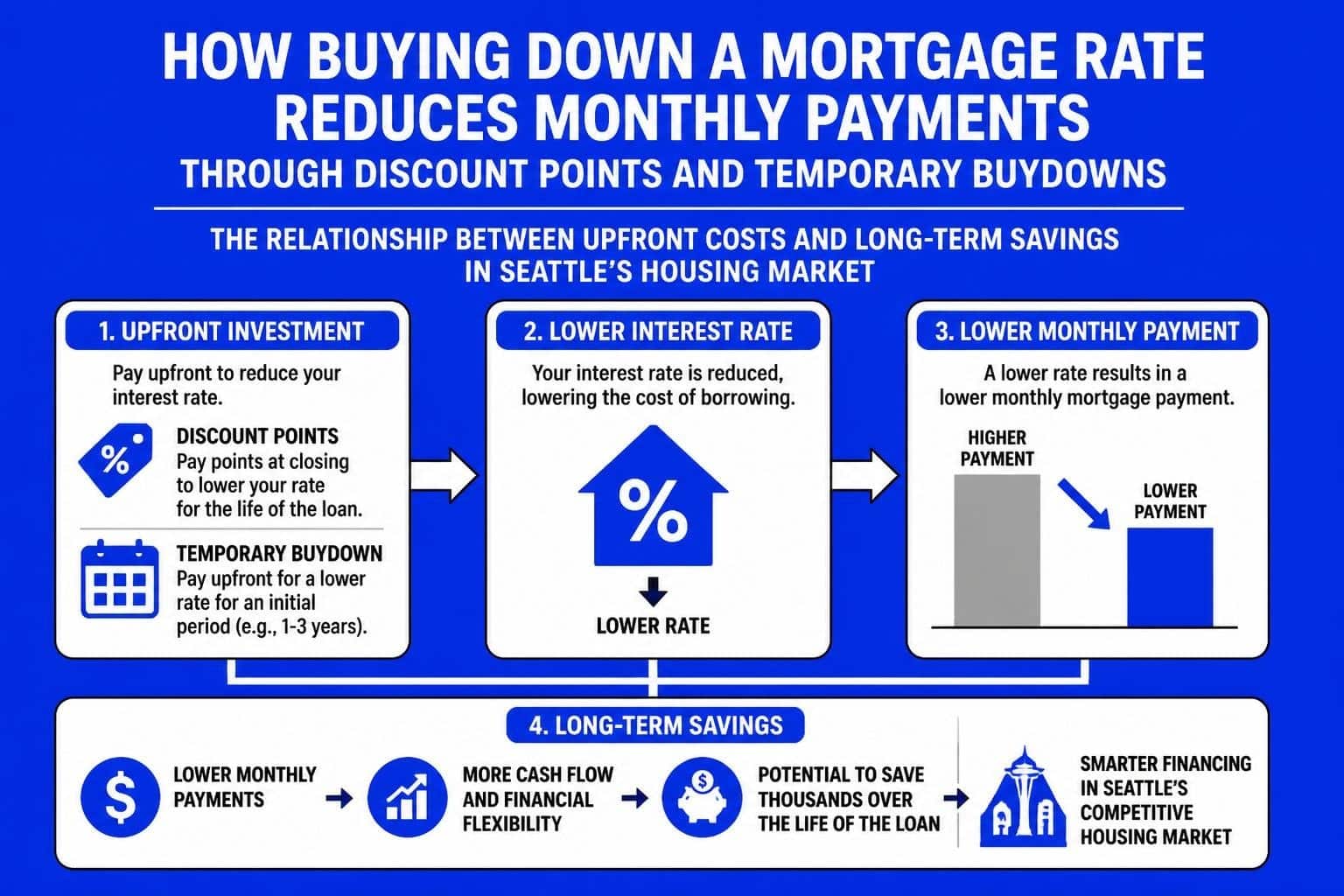
More selection also creates negotiating leverage on homes that have lingered. Price reductions, seller-paid closing cost credits, rate buydown assistance, and inspection repairs have all returned as normal parts of successful transactions. These tools simply didn’t exist in the peak market.
2. Prices Are Stable — Not Crashing, Not Surging
Seattle home prices are essentially flat year-over-year — a healthy recalibration after years of double-digit appreciation. Most forecasts call for 2–5% price appreciation metro-wide through the rest of 2026, with variation by neighborhood.
What this means practically: you’re unlikely to buy into a falling market, but you’re also unlikely to face the pressure of rapid price escalation that defined 2020–2022. Buyers have time to make good decisions rather than overpaying in a panic.
3. Wage Growth Is Outpacing Home Price Growth for the First Time in Years
This is a significant structural shift. For most of the past decade, Seattle home prices grew faster than incomes, steadily eroding affordability. In 2026, the equation has flipped: wage growth is expected to outpace home price appreciation for the first time in years. That means every month of stable or modest home price growth, combined with continued income growth among Seattle’s tech workforce, improves the long-term affordability picture incrementally.
4. Rents Aren’t a Safe Harbor Either
The alternative to buying is continuing to rent — and Seattle rents are not declining. Rents are expected to grow 3–4% in 2026, with particular pressure in transit-connected neighborhoods and tech corridors. For a renter paying $3,500/month, a 3% increase means $105 more per month — $1,260 more per year — with nothing building toward equity or net worth.
The rent-vs-buy math remains genuinely complex in Seattle given high prices and current mortgage rates, but renting is not a “free” alternative. Every year of renting is a year of not building equity in one of the country’s most consistently appreciating long-term markets.
5. Seattle’s Long-Term Fundamentals Are Intact
This is ultimately the most important argument for buyers with a 5–10+ year horizon:
- Geographic supply constraints: Seattle is bounded by Puget Sound to the west, Lake Washington to the east, and mountains beyond that. New housing supply is structurally limited.
- Tech employment: Amazon, Microsoft, Google, Salesforce, Meta, and hundreds of smaller tech companies continue to anchor one of the highest-income workforces in the country.
- Population growth: Seattle and the greater Puget Sound region continue to attract net in-migration of high-income workers.
- Long-term appreciation: The median sold price in 2025 was up approximately 88% compared to 2016 — a trajectory that reflects structural demand, not speculation.
Buyers who enter this market with a long-term perspective have historically been rewarded. That track record doesn’t guarantee future returns, but it’s a meaningful data point.
The Case For Caution
1. Mortgage Rates Are Still Elevated
Let’s be honest about this. At 6.4–6.7%, monthly payments on Seattle’s median home are substantially higher than they were even three years ago. On an $850,000 home with 20% down ($170,000), a 30-year mortgage at 6.5% carries a monthly payment of approximately $4,300 — principal and interest only, before taxes, insurance, and any HOA. That’s a significant monthly commitment, and it’s genuinely higher than many buyers are comfortable with.
Buyers who stretched to their maximum qualifying amount at current rates leave themselves little financial buffer. The most important question isn’t whether the market is ready — it’s whether your budget is.
2. Rate Volatility Is Real
Mortgage rates have moved meaningfully higher in April 2026 due to global economic pressures. Buyers who locked in expectations at 6.1% rates in early March found themselves looking at 6.5%+ a few weeks later. Rate volatility adds uncertainty to payment planning and can affect qualification. Rates could improve — or they could stay elevated longer than forecasters expect. Anyone making a major purchase decision should plan for rates in the current range, not the lower end of recent forecasts.
3. Affordability Remains Historically Stretched
Despite modest price declines and income growth, Seattle remains one of the least affordable major housing markets in the country. The price-to-income ratio is far above historical norms. First-time buyers without family wealth, existing equity, or high tech salaries face genuine headwinds. The market has improved — but it hasn’t fundamentally reset.
4. The Market Is Not Uniform
It’s a mistake to talk about “Seattle real estate” as a single market. Conditions vary dramatically:
- High-demand neighborhoods (Ballard, Capitol Hill, Queen Anne, Bellevue eastside) remain very competitive, with well-priced homes still receiving multiple offers quickly
- Condo market: Inventory is up over 22% year-over-year, creating more buyer leverage than single-family homes
- Entry-level price points face the most affordability pressure from rates
- $1.5M+: Buyers in this segment are often competing with all-cash or near-cash buyers and face different dynamics entirely
Understanding where your target homes sit within these micro-markets matters as much as the overall headline numbers.
The Question That Actually Matters: Is It a Good Time For You?
“Is it a good time to buy?” is actually the wrong question. The right question is: “Is it a good time for me to buy, given my finances, timeline, and goals?”
Here’s a framework to think through:
Buying likely makes sense if:
- You plan to stay in the home for at least 5–7 years (enough time to ride out any near-term price softness and build equity through paydown and appreciation)
- Your monthly housing payment (mortgage + taxes + insurance + any HOA) would be manageable within your budget without stretching uncomfortably
- You have a stable income that’s likely to continue — ideally in Seattle’s strong tech or professional sector
- You have reserves beyond the down payment — 3–6 months of mortgage payments in savings after closing
- You’ve been renting and your rent is high and likely to keep rising
- You have a specific reason to be in Seattle long-term — career, family, community — not just following the market
Waiting may make more sense if:
- You’re not sure where you’ll be in 3 years (job changes, family situations, possible relocation)
- Buying at today’s prices and rates would require stretching your budget to its absolute limit
- You need more time to save for a down payment and build cash reserves
- Your credit needs improvement before you’ll qualify for the best available terms
- You’re buying out of fear of missing out rather than genuine readiness
Don’t Try to Time the Market — But Do Time Your Purchase
Here’s one of the most consistent truths in Seattle real estate: people who wait for the “perfect” moment almost always wait too long. The market moves through cycles — but Seattle’s long-term trajectory has been upward, and the structural reasons for that (supply constraints, strong employment, continued demand) remain firmly in place.
That said, the worst time to buy is when you’re financially underprepared, buying more home than you can comfortably afford, or making a decision driven by emotional urgency rather than financial clarity.
The best approach: get financially prepared, understand what you can genuinely afford at current rates (not hypothetical lower rates), and buy when the right home comes along at a price that makes sense — without forcing it.
A Practical Snapshot: Monthly Cost at Today’s Prices and Rates
To make this concrete, here’s what the monthly cost of ownership looks like at different price points with a 20% down payment at 6.5%:
| Purchase Price | Down Payment (20%) | Loan Amount | Monthly P&I | Est. Taxes + Insurance | Approx. Total Monthly |
|---|---|---|---|---|---|
| $650,000 | $130,000 | $520,000 | ~$3,288 | ~$700 | ~$3,988 |
| $850,000 | $170,000 | $680,000 | ~$4,300 | ~$900 | ~$5,200 |
| $1,100,000 | $220,000 | $880,000 | ~$5,564 | ~$1,100 | ~$6,664 |
| $1,400,000 | $280,000 | $1,120,000 | ~$7,081 | ~$1,400 | ~$8,481 |
Monthly P&I calculated at 6.5% on a 30-year fixed mortgage. Property taxes estimated at approximately 1% of purchase price annually. Homeowner’s insurance estimated. HOA fees not included. These are estimates for illustrative purposes only.
If these numbers work within your budget — leaving room for savings, retirement contributions, and life expenses — then the market question becomes secondary. If they don’t, that’s an honest signal to keep saving and wait for conditions that align.
The Bottom Line
2026 is a better time to buy in Seattle than 2021 or 2022 for most buyers — if you’re financially prepared. More inventory, less panic, stable prices, and a market that rewards research and negotiation rather than pure speed and aggression.
It’s not cheap. It’s not easy. But it’s functional, and Seattle’s long-term fundamentals give buyers with a genuine horizon good reasons for confidence.
What it’s not: a moment to stretch beyond your means, rush a decision, or buy because you’re afraid prices might escape you. The buyers who get hurt in any market are the ones who bought at the edge of their financial capacity without adequate preparation.
The honest answer to “is it a good time to buy?” is: it depends entirely on your financial readiness, timeline, and goals. The market conditions in 2026 are supportive — what matters is whether you are.
We’ll run through the real numbers with you — what you qualify for at today’s rates, what your monthly payment looks like at different price points, and what a realistic path to homeownership in Seattle looks like for your specific situation. No pressure, no sales pitch — just clarity.
Disclaimer: Market data referenced in this article reflects publicly available information from Redfin, Zillow, the Northwest Multiple Listing Service (NWMLS), and other sources as of April 2026. Real estate market conditions change frequently. Price forecasts are speculative and not guarantees of future performance. Monthly payment estimates are illustrative and based on stated assumptions. This article is not financial advice. Always consult with qualified real estate and mortgage professionals before making major financial decisions.
Key Takeaways
- 2026 presents a window for homebuyers in Seattle; more inventory and stabilizing prices create less competition than in previous years.
- Median home prices remain stable at around $850,000; buyers face less pressure to make hasty decisions compared to 2021-2022.
- Homebuyers benefit from stronger wage growth that outpaces price growth for the first time in years, improving affordability.
- Despite market improvements, mortgage rates are higher than in recent years, making monthly payments significant for many buyers.
- Ultimately, the decision to buy depends on individual financial readiness and long-term plans, not just market conditions.