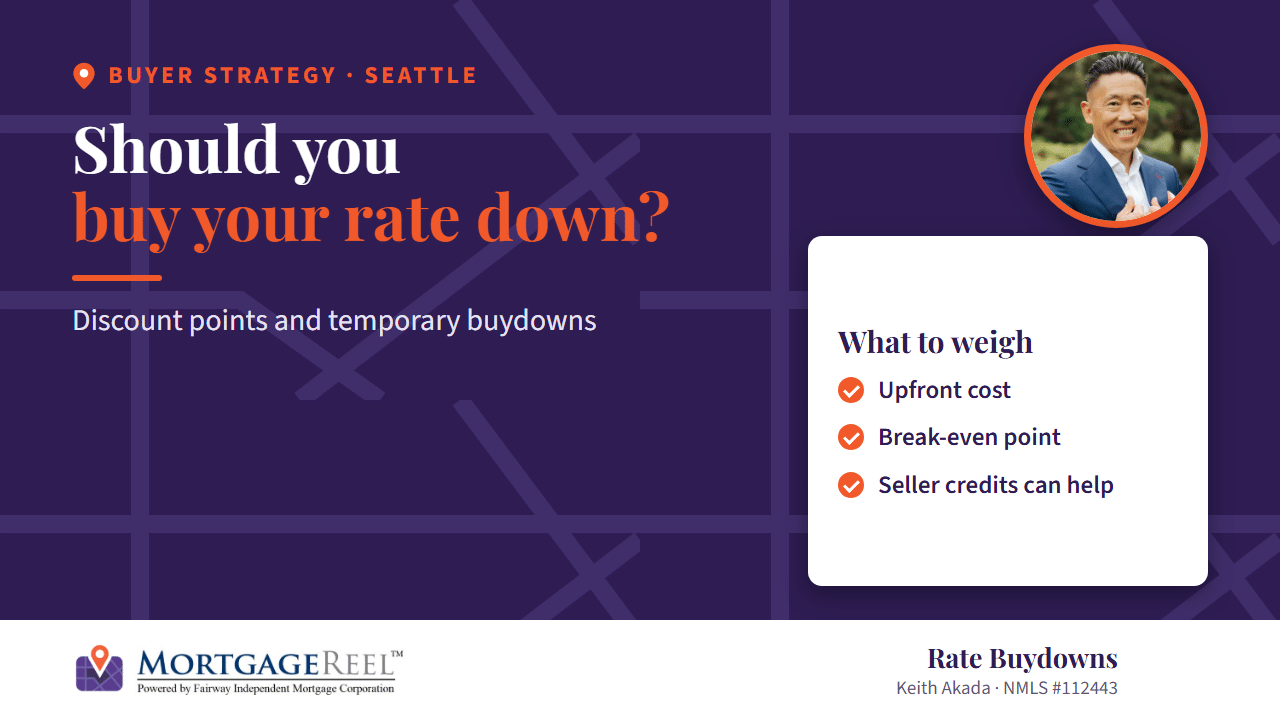
Buying a mortgage rate down means paying extra at closing, or having a seller or builder pay it, to get a lower interest rate. Discount points lower your rate for the life of the loan, with one point costing 1% of the loan amount. Temporary buydowns lower your payment for the first one to three years. Points usually pay off only if you keep the loan past your break-even month.
I have spent more than 25 years helping Puget Sound buyers decide whether buying down a rate is worth it, and the answer depends far more on how long you keep the loan than on the rate itself. Here is how each option works and how to run the math.
How Discount Points Work
A discount point is an optional fee you pay your lender at closing in exchange for a permanently lower interest rate. One point equals 1% of your loan amount, so one point on a $800,000 loan costs $8,000. How much each point lowers your rate is set by the lender's pricing that day and varies by loan type, loan size, and market conditions, which is why it is worth seeing quotes with and without points.
Points appear in Section A, Origination Charges, of your Loan Estimate. You can also go the other direction and accept a slightly higher rate in exchange for a lender credit that covers some of your closing costs.
How Temporary Buydowns Work
A temporary buydown lowers your payment for the first years of the loan, then your payment returns to the full note rate. The cost is prepaid, usually by a seller or builder, into an account that covers the difference each month.
- 2-1 buydown: year one's payment is calculated at a rate 2 percentage points below your note rate, year two at 1 point below, then the full payment from year three on.
- 1-0 buydown: year one at 1 point below the note rate, then the full payment.
- 3-2-1 buydown: three steps over the first three years, less common and more expensive.
Two things to know. You qualify for the loan at the full note rate, not the reduced first-year payment, so the buydown helps cash flow but not qualifying. And if you sell or refinance early, unused buydown funds are typically applied to your loan rather than lost, depending on the program.
| Feature | Discount points | Temporary buydown |
|---|---|---|
| How long it lasts | Life of the loan | First 1 to 3 years |
| Who usually pays | Buyer, or seller through a credit | Seller or builder |
| Helps you qualify? | Yes, lower full payment | No, you qualify at the full rate |
| Best for | Keeping the loan for many years | Easing the first years of ownership |
The Break-Even Math
Divide what the points cost by how much they lower your monthly payment. The result is the number of months before the points pay for themselves.
As an illustrative example, if one point on a $800,000 loan costs $8,000 and lowers your monthly payment by $130, you break even in about 62 months, a little over five years. Keep the loan longer and the points save you money; sell or refinance sooner and you would have been better off without them. These figures are illustrative only; your numbers come from an actual Loan Estimate.
Two refinements matter. Money spent on points is money not available for reserves, a larger down payment, or investments, so weigh what else that cash could do. And if you think there is a real chance you will refinance within a few years, points become a bet against that happening.
When Buying Down Your Rate Makes Sense
- You plan to keep the loan well past the break-even month, such as a family settling into a school district for the long haul.
- Someone else is paying. Seller or builder credits for a buydown cost you nothing out of pocket.
- You have cash beyond your reserves and prefer a permanently lower payment over keeping it liquid.
- A lower payment helps you qualify for the loan amount you need.
When to Skip It
- You may move, sell, or relocate within a few years
- Paying points would leave you short on reserves or emergency savings
- You expect to refinance soon
- The lender's pricing gives you only a small rate improvement per point
Seller and Builder-Paid Buydowns
In slower markets and in new construction around Mill Creek, Lynnwood, and Everett, sellers and builders often offer credits that can be used for points or a temporary buydown. A credit toward a buydown can be worth more to you than the same dollars off the price, because it lowers your payment directly.
Each loan type limits how much a seller can contribute:
| Loan type | Maximum seller contribution |
|---|---|
| Conventional, less than 10% down | 3% of the price |
| Conventional, 10% to 25% down | 6% |
| Conventional, more than 25% down | 9% |
| Conventional, investment property | 2% |
| FHA | 6% |
| VA | Normal closing costs plus up to 4% in concessions |
With builder offers, read the fine print. Some incentives require using the builder's preferred lender, so compare the full package, including the base rate and fees, against an outside Loan Estimate before you choose.
Limits on Points and Fees
For most loan sizes, Qualified Mortgage rules cap total points and fees at 3% of the loan amount, so there is a practical ceiling on how many points you can buy. In practice, the first point or two usually deliver the most rate improvement for the money.
Are Mortgage Points Tax Deductible?
Points paid to buy a primary home are often deductible in the year you pay them if you itemize, and the IRS treats seller-paid points as paid by you for this purpose. Points on a refinance are usually deducted over the life of the loan. This is not tax advice, so check with a tax professional about your situation.
How to Compare Buydown Offers
Ask each lender for a Loan Estimate on the same day, for the same loan amount, at zero points and with one point. Then compare the rate, Section A charges, and any lender credits side by side, and run the break-even on each. A lender with a lower starting rate may beat one with a cheaper point. My guide to mortgage broker charges and the Loan Estimate shows exactly where each cost appears, and my Seattle mortgage rates page shows this week's sample pricing with points.
As a loan officer at Fairway Independent Mortgage, a direct lender with in-house underwriting, I lay out these options on actual Loan Estimates before you decide, and my team closes in 9 business days when your offer needs to stand out. See also refinancing in Seattle and conventional home loans.
Buying a Mortgage Rate Down: FAQs
How much does it cost to buy down a mortgage rate?
Each discount point costs 1% of your loan amount, so one point on a $800,000 loan is $8,000. How much a point lowers your rate depends on the lender's pricing that day, so compare quotes with and without points.
Is it worth buying mortgage points?
It is worth it when you keep the loan well past your break-even point, which is the cost of the points divided by your monthly savings. If you may sell or refinance within a few years, keeping the cash is usually the better choice.
What is a 2-1 buydown?
A temporary buydown where your first-year payment is based on a rate 2 percentage points below your note rate and your second-year payment 1 point below, before the full payment starts in year three. It is usually funded by a seller or builder, and you still qualify at the full note rate.
Can the seller pay for my rate buydown?
Yes, within your loan type's limits. Conventional loans allow seller contributions of 3% to 9% of the price depending on your down payment (2% on investment properties), FHA allows 6%, and VA allows normal closing costs plus up to 4% in concessions.
Is there a limit on how many points I can buy?
For most loan sizes, Qualified Mortgage rules cap total points and fees at 3% of the loan amount. The first point or two usually deliver the most rate improvement for the money.
Are discount points tax deductible?
Points paid to buy a primary home are often deductible in the year paid if you itemize, including seller-paid points, while refinance points are usually deducted over the loan's life. This is not tax advice, so check with a tax professional.
Let's connect. Call or text (206) 601-3426, email keith@mortgagereel.com, start your application, or book a time to talk. I will show you the break-even on points before you decide, pressure-free.