

1st time home buyer programs in Seattle let most buyers pair a low down payment mortgage with down payment assistance. The main sources are WSHFC (Home Advantage and House Key Opportunity), the City of Seattle (up to $76,000 for buyers under 80% of area median income), ARCH on the Eastside, and county programs.
Buying your first home in the Greater Seattle area can feel overwhelming, especially with median prices in neighborhoods from Shoreline to Everett continuing to challenge budgets. Fortunately, 1st time home buyer programs exist specifically to reduce financial barriers and make homeownership achievable. These programs offer down payment assistance, reduced interest rates, flexible credit requirements, and educational resources designed to give new buyers a competitive edge. Understanding which options align with your financial situation and homeownership goals is essential, particularly in markets like Seattle, Bellevue, and Redmond where inventory moves quickly and prices remain elevated.
Understanding 1st Time Home Buyer Programs
First-time homebuyer programs encompass a range of federal, state, and local initiatives designed to assist individuals purchasing their first property. The definition of a "first-time buyer" is more flexible than many people realize. Generally, you qualify if you haven't owned a home in the past three years, making these programs accessible even to those who previously owned property.
Federal Programs Available Nationwide
Several federal programs provide foundational support for new buyers across the country. FHA loans remain one of the most popular options, requiring as little as 3.5% down with credit scores as low as 580. These government-backed mortgages allow buyers to finance their purchase with minimal cash reserves while benefiting from competitive interest rates.
VA loans serve military members, veterans, and eligible spouses with zero down payment requirements and no private mortgage insurance. For Seattle-area buyers working at Joint Base Lewis-McChord or with military service history, this represents substantial savings over conventional financing.
USDA loans offer another zero-down option, but only in eligible rural areas. Seattle and close-in suburbs like Lynnwood, Mill Creek, and Everett do not qualify. Eligible addresses tend to show up in smaller towns farther out in Snohomish County, so check any address on the USDA eligibility map before you plan around it.
The U.S. Department of Housing and Urban Development provides comprehensive details on these federal programs and eligibility requirements for buyers nationwide.
Washington State Housing Finance Commission Programs
Washington State offers some of the most robust 1st time home buyer programs in the country through the Washington State Housing Finance Commission (WSHFC). These programs combine competitive interest rates with down payment assistance to maximize affordability.
Home Advantage Program
Home Advantage is WSHFC's main first mortgage (conventional, FHA, VA, or USDA), and it always comes paired with down payment assistance. The assistance is 3%, 4%, or 5% of your loan amount at 0% interest with no monthly payment, and it is repaid when you sell, refinance, or pay off the first mortgage. You do not have to be a first-time buyer, but every borrower takes WSHFC's free homebuyer education class.
WSHFC currently lists a $215,000 household income cap for Home Advantage assistance (effective September 2025). That is high enough to fit many Seattle-area dual-income households, including some tech employees with RSU income, which makes Home Advantage the WSHFC option I use most often. Details are on WSHFC's down payment assistance page.
House Key Program
House Key Opportunity pairs a WSHFC first mortgage with up to $15,000 of down payment assistance at 1% simple interest, deferred until you sell, refinance, or pay off the loan. It is not forgiven. You generally need to be a first-time buyer (veterans and Target Area purchases are exceptions), and in King and Snohomish counties the purchase price cap is $725,000, or $775,000 in Target Areas.
Income limits are lower than Home Advantage. In King and Snohomish counties, House Key assistance is limited to household incomes of $93,350 for one or two people and $116,650 for three or more (effective June 2026). Between the price cap and the income limit, House Key tends to fit condos and townhomes in Shoreline, Lynnwood, or Everett better than detached homes in Seattle.
| Program | Assistance | King and Snohomish limits | Fits |
|---|---|---|---|
| Home Advantage | 3%, 4%, or 5% of the loan, 0% interest, deferred | Income up to $215,000 | Moderate to higher incomes; first-time status not required |
| House Key Opportunity | Up to $15,000, 1% simple interest, deferred | Income $93,350 to $116,650; price up to $725,000 | Lower incomes, condos and townhomes |
| Home Choice | Up to $15,000, deferred | Income up to $164,400 | Households with a member who has a disability |
Home Choice Program
Home Choice is down payment assistance of up to $15,000, deferred, for buyers who have a disability or have a family member with a disability living in the home. It pairs with Home Advantage or House Key, requires a one-on-one counseling session, and in King and Snohomish counties is open to household incomes up to $164,400.
Buying on the Eastside? ARCH, a partnership of East King County cities, offers down payment assistance of up to $30,000 at 4% simple interest through WSHFC for income-qualified buyers in cities like Bellevue, Kirkland, and Redmond.
Down Payment Assistance Programs
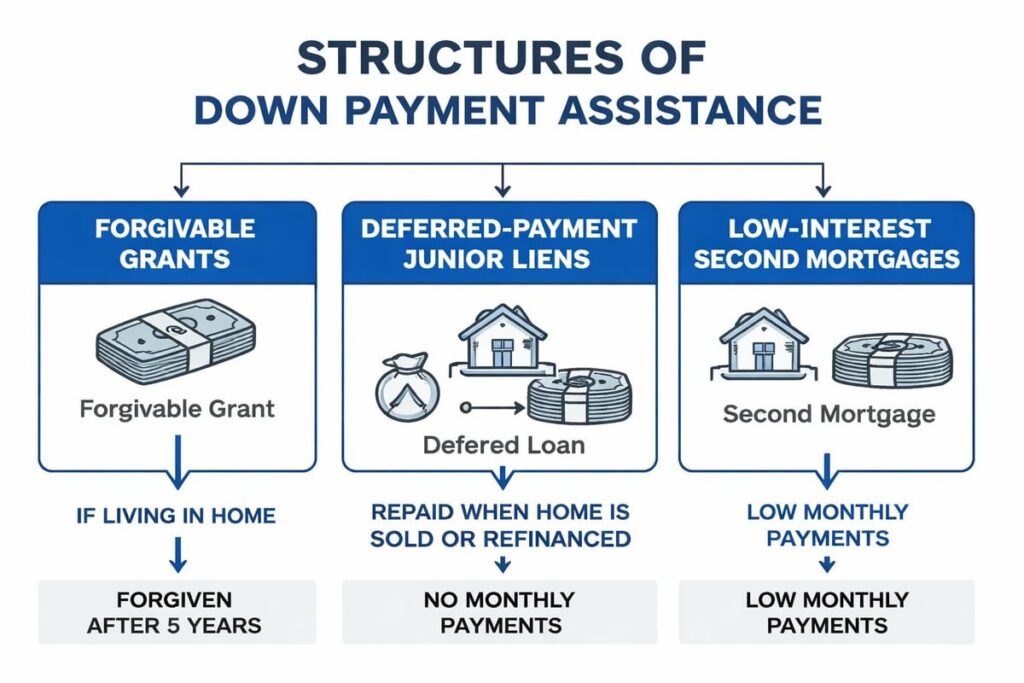
Down payment assistance represents one of the most significant benefits available through 1st time home buyer programs. These funds come in various forms, each with distinct repayment terms and eligibility criteria.
Grant programs provide money that does not require repayment, as long as you meet occupancy and ownership requirements for a set period. True grants are rare in the Seattle area, and most help here comes as a deferred loan instead.
Deferred-payment loans create a junior lien on your property with no monthly payment required. The loan becomes due when you sell, refinance, or no longer live in the home. A few local programs forgive these loans over time, but WSHFC's assistance is not forgiven; it is repaid at sale, refinance, or payoff.
Low-interest second mortgages require monthly payments but offer rates significantly below market. These work well for buyers who can afford slightly higher monthly costs in exchange for immediate purchasing power.
Freddie Mac’s homebuyer resources outline additional conventional options that may include reduced down payment requirements and built-in affordability features.
Conventional 3% Down Options
Beyond government-backed programs, conventional mortgages now offer 3% down payment options through programs like HomeReady and Home Possible. These 1st time home buyer programs provide flexibility without FHA mortgage insurance requirements that persist for the loan's life.
HomeReady Advantages
Fannie Mae's HomeReady program allows 3% down for buyers earning up to 80% of area median income, with lower mortgage insurance costs than a standard conventional loan. In some cases it can also count rental income from a boarder, which helps multigenerational households common in Seattle's diverse communities.
One catch for tech buyers: HomeReady and Home Possible cap income at 80% of area median income. For 2026, Fannie Mae and Freddie Mac set area median income at $151,200 in both King and Snohomish counties, so the cap is $120,960. Many Amazon and Microsoft households earn more than that once RSUs are counted, so standard conventional financing is usually the better fit for them.
Home Possible Benefits
Freddie Mac's Home Possible offers similar 3% down financing with the same 80% of area median income cap. Education requirements depend on your situation, and I will tell you up front whether your file needs a course.
First-Time Buyers Earning Up to 120% of Area Median Income
There is also a benefit for first-time buyers who earn too much for HomeReady or Home Possible. On conventional loans sold to Fannie Mae and Freddie Mac, the two agencies waive certain upfront pricing charges, called loan-level price adjustments, for first-time buyers whose qualifying income is at or below 120% of area median income in high-cost areas like King, Snohomish, and Pierce counties. Those adjustments are normally added to a conventional loan based on factors like your credit score and down payment, so removing them can mean better pricing on the same loan.
To qualify, typically:
- At least one borrower is a first-time buyer, which generally means not having owned a home in the past three years.
- The home will be your primary residence.
- Qualifying income is at or below the limit. For 2026, area median income is $151,200 in King, Snohomish, and Pierce counties, so the 120% limit is $181,440. Only the income used to qualify for the loan counts, not the earnings of household members who are not on the loan.
Here is what that means in practice. Many Seattle first-time buyers land right in this range: above the $120,960 HomeReady and Home Possible cap, but under $181,440. The waiver does not lower your down payment or remove mortgage insurance, so with less than 20% down, standard mortgage insurance still applies. Fannie Mae and Freddie Mac set the rules, their underwriting systems flag whether a loan qualifies, and the limits update every year (the 2026 figures took effect June 13, 2026). You can check the limit for any address with Fannie Mae’s area median income lookup tool. Current pricing for first-time buyers in this income range is on my Seattle mortgage rates page. Whether the waiver applies depends on your full loan profile, and every loan is subject to credit approval and a full loan estimate.
Local City and County Programs
King and Snohomish counties offer additional 1st time home buyer programs that layer with state and federal options to maximize assistance.
Seattle Office of Housing
The City of Seattle funds down payment assistance of up to $76,000 per household for first-time buyers earning under 80% of area median income and buying within city limits. The city works through partners (HomeSight, Habitat for Humanity Seattle-King County, Homestead Community Land Trust, and Parkview Services), and terms vary by partner. HomeSight, for example, lists 3% interest deferred for 30 years. Homebuyer education and counseling are required. Details are on the City of Seattle Office of Housing site.
The city's income limits follow HUD's figures, which are different from Fannie Mae's. For FY2026, HUD set the median family income for King and Snohomish counties at $164,400, and the 80% limit runs from $81,700 for one person to $154,000 for a household of eight.
Snohomish County HOME Program
Outside Seattle, county programs fill some of the gap. HomeSight currently lists Snohomish County assistance of up to $50,000 at 3%, deferred for 30 years, for income-qualified buyers, and King County assistance of up to $45,000 for Auburn, Federal Way, Tukwila, and unincorporated King County. Funding opens and closes during the year, so confirm availability before you plan around it.
These programs often have application deadlines and limited annual funding, making early preparation and quick action essential when funds become available.
Credit and Income Requirements
Understanding qualification criteria for 1st time home buyer programs helps you prepare effectively and choose the right option for your financial profile.
Minimum Credit Scores
Most programs require minimum credit scores between 580 and 640, though specific requirements vary by program and lender. FHA loans accept scores as low as 580 with 3.5% down or 500 with 10% down. Conventional programs typically require 620 or higher, with better rates available above 680.
Building credit before applying improves both program eligibility and interest rate pricing. Focus on these priorities:
- Pay all bills on time for at least 12 months before applying
- Reduce credit card balances below 30% of limits
- Avoid opening new credit accounts in the six months before purchase
- Dispute any credit report errors well in advance
Income Documentation Standards
1st time home buyer programs generally require two years of employment history and income documentation, though exceptions exist for recent graduates and those changing careers. Acceptable documentation includes:
- W-2 forms and recent pay stubs for salaried employees
- Tax returns and profit/loss statements for self-employed buyers
- RSU vesting schedules and stock compensation statements
- Offer letters and employment verification for new positions
Tech professionals in Seattle often have complex income structures combining base salary, bonuses, stock grants, and equity compensation. Working with a mortgage broker experienced in documenting these income sources ensures maximum qualifying power and program eligibility.
The Consumer Financial Protection Bureau’s guide to owning a home explains documentation requirements and mortgage qualification standards in detail.
Homebuyer Education Requirements
Many 1st time home buyer programs require completion of an approved homebuyer education course before closing. These courses cover essential topics including budgeting, mortgage types, the purchase process, and homeownership responsibilities.
Course Benefits
Education requirements provide genuine value beyond program qualification. You'll learn to:
- Calculate realistic budgets including taxes, insurance, and maintenance
- Compare loan programs and understand rate locks and points
- Navigate inspection, appraisal, and closing processes confidently
- Identify predatory lending practices and avoid common mistakes
- Plan for long-term homeownership costs and equity building
Available Formats
Courses are available online and in-person through HUD-approved counseling agencies. Online courses offer flexibility for busy professionals, while in-person sessions provide opportunities to ask specific questions about Seattle-area market conditions.
WSHFC's own class is free, takes about five hours, and is offered online and in person. An online alternative through eHome America costs $50 per person. Every borrower who signs the loan must attend, and certificates are typically valid for two years, so you can finish early while you save. I cover the class options in more detail in my first-time home buyer courses guide.
Tax Benefits and Additional Incentives
First-time homebuyers gain access to tax advantages that improve overall affordability beyond program assistance.
Mortgage Interest Deduction
Interest paid on mortgages up to $750,000 is generally tax-deductible, providing substantial savings for buyers in Seattle's higher-priced market. This deduction reduces your effective mortgage cost, particularly in the early years when interest comprises most of your payment. This is not tax advice, so talk to a tax professional about your situation.
Mortgage Credit Certificates Are Not Currently Available
Washington's Mortgage Credit Certificate (MCC) program, which turned part of your mortgage interest into a federal tax credit, is not currently available for new home purchases, according to WSHFC. Homeowners who already have an MCC can still have it reissued when they refinance. If you read about MCCs on other sites, that information is likely out of date.
Property Tax Exemptions
Some Washington jurisdictions offer property tax exemptions for new construction or designated development areas. While not specifically first-time buyer programs, these exemptions can significantly reduce ownership costs during the initial years.
Common Mistakes to Avoid
New buyers often encounter preventable obstacles when pursuing 1st time home buyer programs. Awareness helps you navigate the process smoothly and maintain program eligibility.
Timing and Application Errors
Applying too late represents a critical mistake. Many assistance programs have application deadlines or limited funding that depletes quickly. Research and apply for programs before starting your home search, ensuring funds are reserved when you find the right property.
Changing employment during the mortgage process can jeopardize approval. Lenders verify employment immediately before closing, and job changes may require restarting qualification with new income documentation.
Making large purchases on credit before closing affects your debt-to-income ratio and potentially disqualifies you from the loan. Avoid financing cars, furniture, or other items until after your mortgage funds.
Program Compliance Issues
Each program includes specific occupancy requirements, typically mandating you occupy the home as your primary residence for a minimum period. Renting the property or purchasing it as an investment violates program terms and may trigger full repayment of assistance.
Understanding recapture provisions prevents surprises. Some programs require repaying assistance if you sell within specific timeframes or if your income increases substantially. Read all program documentation carefully and ask questions about any unclear terms.
Combining Multiple Programs
Strategic buyers often layer multiple 1st time home buyer programs to maximize assistance and minimize out-of-pocket costs. This approach requires careful coordination but can significantly improve affordability.
A common Seattle combination pairs a WSHFC first mortgage and its down payment assistance with the City of Seattle's assistance for income-qualified buyers. Here is how that can look:
- WSHFC Home Advantage first mortgage with 4% down payment assistance at 0%, deferred
- City of Seattle assistance through a partner such as HomeSight, up to $76,000 for buyers under 80% of area median income
- Your own funds or a family gift for the rest of the down payment and closing costs
This example is illustrative only, not an offer. Actual amounts depend on your income, purchase price, program funding, and approval, and are subject to a full loan estimate.
Program stacking requires understanding how different assistance sources interact and ensuring you meet all eligibility requirements simultaneously. Some programs explicitly allow combining while others prohibit it, making expert guidance valuable.
Special Considerations for Tech Professionals
Seattle-area tech employees face unique opportunities and challenges when accessing 1st time home buyer programs. Stock compensation, restricted stock units, and performance bonuses create substantial income but require specialized documentation.
RSU and Stock Income Qualification
RSU income can count toward qualifying once it has vested and been paid out to you. Under Fannie Mae's current rules, time-based RSUs need at least 12 months of history with your current employer, and the income is averaged over the last 24 months using the stock's 200-day moving average price. I break down the math in how RSUs impact mortgage approval.
For Amazon employees with substantial RSU packages, this often means qualifying for significantly higher loan amounts than base salary alone would support. However, program income limits sometimes create complications, as total compensation including stock may exceed thresholds while base salary remains under limits.
Bonus and Variable Income
Annual bonuses and variable compensation generally require a two-year history for qualification purposes. Lenders average the amounts received and may discount inconsistent bonuses or declining trends.
Microsoft employees with predictable bonus structures find qualification straightforward, while those in sales roles or with highly variable compensation may need additional documentation explaining income sources and sustainability.
Navigating Seattle's Competitive Market
Using 1st time home buyer programs effectively in Seattle's fast-moving market requires strategy and preparation. Multiple offers remain common in desirable neighborhoods, and sellers may favor conventional financing over government-backed loans.
Strengthening Your Offer
Despite using assistance programs, you can compete effectively by:
- Getting fully underwritten pre-approval before making offers
- Offering shorter inspection periods when confident in property condition
- Including escalation clauses with competitive caps
- Closing quickly. My team closes in 9 business days, which carries real weight when a seller is comparing offers
- Demonstrating financial strength through substantial reserves
Conventional 3% down programs often compete more effectively than FHA financing because they don't require FHA appraisal standards that sometimes challenge older Seattle homes.
Working with Experienced Professionals
Real estate agents familiar with 1st time home buyer programs understand how to position your offer competitively while using assistance. They can identify sellers likely to accept program financing and negotiate terms that protect your interests while appealing to seller priorities.
USA.gov’s home buying guide provides general information about the purchase process and federal resources available to new buyers.
Application Process and Timeline
Understanding the application timeline for 1st time home buyer programs helps you plan effectively and avoid delays that could cost you a desired property.
Pre-Qualification Phase
Start by gathering financial documentation and researching available programs 6-12 months before your target purchase date. This allows time to:
- Complete required homebuyer education courses
- Build or repair credit to meet minimum score requirements
- Save additional funds for down payment and reserves
- Research neighborhoods and price ranges within your budget
- Apply for assistance programs with application deadlines
Formal Application Steps
Once you're ready to purchase, the formal process typically follows this sequence:
- Submit assistance program applications and receive conditional approval or funding reservation
- Obtain pre-approval from a lender who participates in your chosen programs
- Search for homes within program price limits and eligible areas
- Make an offer and enter into a purchase agreement
- Finalize assistance program approval with property-specific information
- Complete underwriting and satisfy all loan conditions
- Close on your home and fulfill occupancy requirements
The entire process from application to closing typically takes 30-45 days for straightforward transactions, though complex income documentation or program coordination may extend this timeline.
Income and Price Limits by County
Understanding county-specific limits for 1st time home buyer programs helps you identify which options align with your situation and target neighborhoods.
| Limit (King and Snohomish) | Figure | As of |
|---|---|---|
| Fannie Mae / Freddie Mac area median income | $151,200 | 2026 |
| First-time buyer fee waiver cap (120%, high-cost area) | $181,440 | 2026 |
| HomeReady and Home Possible cap (80%) | $120,960 | 2026 |
| HUD median family income (WSHFC, City of Seattle) | $164,400 | FY2026, effective May 1, 2026 |
| HUD 80% limit, 1 to 8 people | $81,700 to $154,000 | FY2026 |
| Home Advantage assistance income cap | $215,000 | Effective Sept. 15, 2025 |
| House Key Opportunity price cap | $725,000 ($775,000 Target Areas) | Effective Sept. 15, 2025 |
| Conforming loan limit, 1 unit | $1,063,750 | 2026 |
Notice there are two different area median income figures. Fannie Mae and Freddie Mac use their own ($151,200), while WSHFC and the City of Seattle follow HUD ($164,400). Which one applies depends on the program, and most limits also vary by household size, so I check the current figures for your household before we pick a program.
Each program sets its own maximum purchase price, and it is often lower than the conforming loan limit, so confirm the current cap with the program before you shop. The 2026 conforming limit of $1,063,750 applies across both King and Snohomish counties, which the FHFA designates as high-cost areas. There is no higher tier above that figure here.
Alternative Paths to Homeownership
When traditional 1st time home buyer programs don't align with your situation, alternative approaches can still make homeownership achievable.
Gift Funds and Family Assistance
Many programs allow using gift funds from family members for down payment and closing costs. Gifts must be properly documented with gift letters confirming the funds require no repayment, but they can supplement your savings significantly.
This approach works particularly well when combined with programs requiring minimal personal down payment, allowing you to use gifted funds for closing costs and reserves while program assistance covers the majority of the down payment.
Individual Development Accounts
Some nonprofit organizations offer Individual Development Account (IDA) programs that match your savings toward homeownership goals. You contribute regularly to a dedicated account, and the organization matches your deposits at rates from 1:1 to 4:1.
These programs typically require financial education and have income eligibility requirements, but they can dramatically accelerate your savings timeline while building financial management skills.
Program Resources and Next Steps
Multiple resources help you identify and access 1st time home buyer programs effectively:
- Washington State Housing Finance Commission (heretohome.org) maintains current program details, income limits, and participating lender lists
- HUD-approved housing counseling agencies provide free guidance on program eligibility and application processes
- Local housing authorities in Seattle, Shoreline, Lynnwood, and other cities offer city-specific assistance information
- Experienced mortgage brokers who specialize in first-time buyer programs can navigate complex qualification and coordinate multiple assistance sources
The Washington State Housing Finance Commission lists every statewide program, with current income and price limits, at heretohome.org.
Begin your preparation by assessing your current financial position, researching programs that match your income and target purchase price, and completing required education courses. This foundation positions you to act quickly when you find the right property and ensures you maximize available assistance.
The competitive Seattle market rewards prepared buyers who understand their options and can move decisively. By combining appropriate 1st time home buyer programs with strategic offer presentation and experienced professional guidance, you can successfully navigate the purchase process and achieve your homeownership goals, even in challenging market conditions like those in Seattle, Bellevue, Redmond, and surrounding communities.
Understanding and accessing 1st time home buyer programs transforms homeownership from aspirational to achievable, particularly in competitive markets throughout the Greater Seattle area. Whether you're considering properties in Shoreline, evaluating options in Lynnwood, or searching in Everett, the right combination of programs and expert guidance makes the difference. Keith Akada brings 25+ years of experience helping first-time buyers navigate complex assistance programs, qualify stock compensation and variable income, and compete effectively in Seattle's challenging market. Ready to explore which programs fit your situation and start your path to homeownership? Connect with Mortgage Reel today for personalized guidance backed by a proven track record of successful first-time buyer closings.
Related guides: Seattle down payment guide, home loans for first-time buyers in Washington, FHA home loans, conventional home loans, and financing a home in Seattle.
1st Time Home Buyer Programs in Seattle: FAQs
Who counts as a first-time homebuyer in Washington?
For most programs, you count as a first-time buyer if you have not owned and lived in a home during the past three years. WSHFC's House Key Opportunity requires it unless you are a veteran or buying in a Target Area, while Home Advantage does not require first-time status at all.
How much down payment assistance can I get in Seattle?
It depends on your income and the program. WSHFC's Home Advantage assistance is 3% to 5% of the loan amount, House Key Opportunity offers up to $15,000, and the City of Seattle offers up to $76,000 for buyers under 80% of area median income. On the Eastside, ARCH offers up to $30,000. Amounts and funding change, and all assistance is subject to approval.
Can I combine more than one first-time buyer program?
Often, yes. A common Seattle structure pairs a WSHFC first mortgage and its assistance with city or county assistance. Each program has its own income and price limits, and your lender has to participate in all of them, so we confirm the combination before you write an offer.
Is down payment assistance forgiven in Washington?
WSHFC's assistance is not forgiven. It is a deferred loan you repay when you sell, refinance, or pay off your first mortgage. City and county programs have their own terms; HomeSight, for example, lists 3% interest deferred for 30 years.
What is the 2026 income limit for first-time buyer programs in King County?
There are several. Fannie Mae and Freddie Mac waive certain upfront fees for first-time buyers earning up to $181,440 (120% of area median income), and cap HomeReady and Home Possible at $120,960. WSHFC's Home Advantage assistance goes up to $215,000, while House Key assistance and City of Seattle help have lower limits based on household size.
Can tech employees with RSUs use first-time buyer programs?
Yes, RSU income counts toward qualifying once you have a reliable history, but it also counts toward income limits. Many Amazon and Microsoft households land above the HomeReady cap, so Home Advantage (up to $215,000) or a standard conventional loan is usually the better fit.
Let's connect. Call or text (206) 601-3426, email keith@mortgagereel.com, or start your application. I will run the numbers on every program you may qualify for, pressure-free.