
Most Seattle-area buyers need far less than a 20% down payment. Conventional loans allow as little as 3% down for qualified buyers, FHA 3.5%, and VA 0% for eligible veterans, while jumbo loans above $1,063,750 typically need 10% to 20%. Down payment assistance can cover part of the rest.
I have helped buyers around Puget Sound for more than 25 years, and the line I hear most is “we are still saving for 20%.” Most of you do not need to wait that long. Whether you are a first-time buyer in Shoreline, a tech professional in Redmond, or a family moving up in Lynnwood, the right down payment is the one that fits your goals, your savings, and your monthly comfort. Start with the calculator below, then read on for how each option works.
SEATTLE DOWN PAYMENT CALCULATOR
How much cash do you actually need to buy?
Enter a price and see the down payment and estimated cash to close for every common loan option in King, Snohomish, and Pierce counties.
Want the full monthly payment too, including property tax, insurance and PMI? Try my Seattle mortgage calculator.
Not sure yet what payment you are comfortable with? Start with my Seattle homebuyer budget worksheet, which builds it from your take-home pay, living costs and savings goals.
How Much Down Payment Do You Actually Need?
The minimum down payment required depends entirely on your loan type, credit profile, and financial situation. Conventional loans backed by Fannie Mae and Freddie Mac allow qualified buyers to put down as little as 3% on primary residences. FHA loans, popular among first-time buyers throughout Seattle and Mill Creek, require just 3.5% down with credit scores as low as 580. VA loans for eligible military members and veterans require zero down payment, making them exceptionally powerful for qualified buyers in Everett and Lake Forest Park.
Here is the quick version by loan type. USDA loans also offer zero-down financing for eligible rural and suburban properties, though availability in King, Pierce and Snohomish Counties is limited compared to more rural Washington areas.
| Loan type | Typical minimum down | Best fit |
|---|---|---|
| VA | 0% | Eligible veterans and service members |
| Conventional | 3% (loans up to $832,750), 5% on high-balance loans | First-time and repeat buyers with solid credit |
| FHA | 3.5% (580+ credit) | Buyers rebuilding or building credit |
| Jumbo (above $1,063,750) | 10% to 20% | Higher-priced homes on the Eastside and in-city |
Conventional Loan Down Payment Options
Conventional financing offers the most flexibility for buyers with strong credit and stable income. Here’s how the down payment tiers work:
- 3% down: Available for first-time buyers and qualified repeat buyers on primary residences
- 5% down: Standard option for most conventional borrowers with good credit
- 10% down: Often unlocks better pricing and rate adjustments
- 15% down: Further reduces mortgage insurance costs
- 20% down: Eliminates private mortgage insurance entirely
The amount you choose affects more than just your upfront costs. It influences your interest rate, monthly payment, and whether you’ll need to pay for private mortgage insurance. For Seattle-area buyers purchasing homes at or above the conforming loan limit ($1,063,750 in 2026 across King and Snohomish counties), a larger down payment may be strategically important to avoid jumbo loan territory or secure better terms.
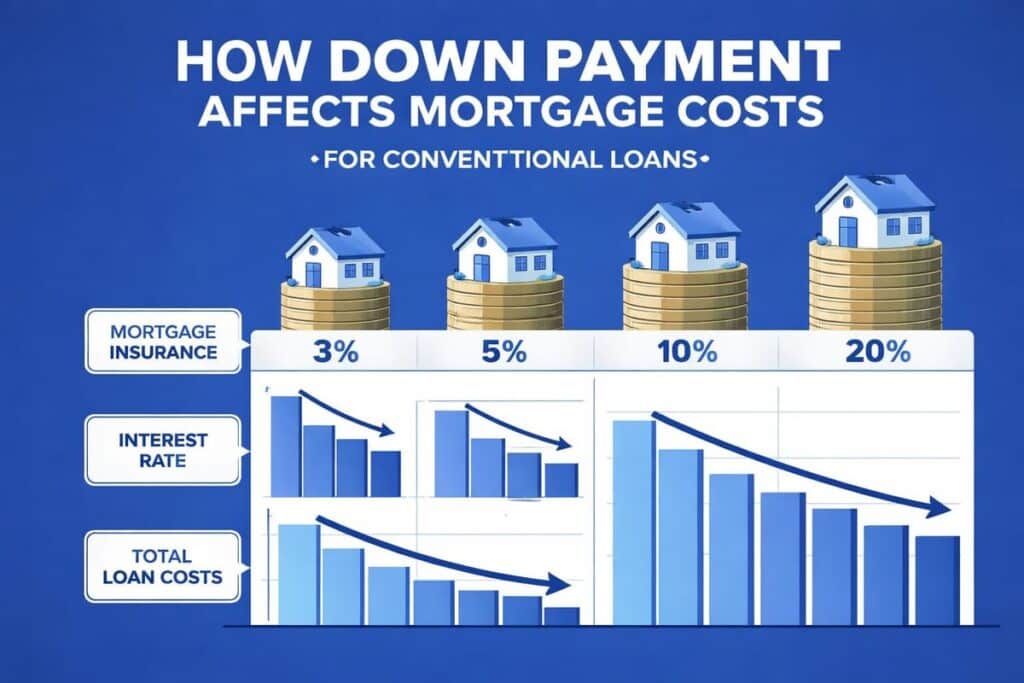
Down Payment Impact on Your Monthly Payment
The relationship between your down payment and monthly housing costs is straightforward: more money down means a smaller loan amount, which translates to lower monthly principal and interest payments. But there’s another significant factor at play: private mortgage insurance, or PMI.
When you put down less than 20% on a conventional loan, lenders require PMI to protect against default risk. Its cost depends mostly on your credit score and down payment, it shrinks as your down payment grows, and it is not permanent (more on removing it below). Here is how the tiers compare on a $600,000 condo in Bellevue.
| Down payment | Cash for down payment | Loan amount | Mortgage insurance |
|---|---|---|---|
| 3% | $18,000 | $582,000 | Required, highest cost |
| 5% | $30,000 | $570,000 | Required |
| 10% | $60,000 | $540,000 | Required, lower cost |
| 20% | $120,000 | $480,000 | None |
This example is illustrative only, not a loan offer. Your actual costs depend on your credit, loan type, and a full loan estimate.
Going from 5% to 20% down in this example lowers the loan by $90,000 and removes mortgage insurance, so your monthly payment drops noticeably. It also ties up $90,000 more of your cash. The right choice depends on your full financial picture, your reserves, and how comfortable you are with monthly cash flow, and I am glad to run the side-by-side numbers for your situation before you decide.
Which tier fits you: 3%, 5%, 10%, or 20%?
Tell me your price range and what you have saved. I will show you the down payment, cash to close, and mortgage insurance trade-off for each option, side by side.
Compare My Options →FHA Loans and Down Payment Flexibility
Federal Housing Administration loans remain exceptionally popular in Seattle’s competitive market, particularly among first-time buyers and those with credit scores below 700. The minimum down payment is 3.5% with a credit score of 580 or higher. Borrowers with scores between 500-579 face a 10% minimum requirement.
FHA loans carry both upfront and annual mortgage insurance premiums regardless of your down payment size. The upfront premium is 1.75% of the loan amount, typically financed into the mortgage. For most buyers putting 3.5% down on a 30-year FHA loan, the annual premium is 0.55% of the loan amount (HUD lowered it in March 2023), and it runs higher on loan amounts above $726,200.
Key Advantages of FHA Financing
Lower credit score requirements make homeownership accessible to buyers rebuilding credit or establishing financial history. Seller concessions up to 6% of the purchase price can cover closing costs, reducing your total cash needed at closing. Gift funds fully allowed from family members provide flexibility for buyers whose savings fall short of the required amount.
VA Loans: Zero Down Payment for Eligible Veterans
Veterans, active-duty service members, and eligible surviving spouses have access to one of the most powerful mortgage products available: VA loans with zero down payment required. This benefit eliminates the largest barrier to homeownership for many military families throughout the Puget Sound region.
Beyond the zero-down advantage, VA loans don’t require monthly mortgage insurance, even with 100% financing. This creates substantial monthly savings compared to conventional and FHA options. VA loans also typically offer competitive interest rates and allow sellers to pay all buyer closing costs and prepaid items.
The VA funding fee is the primary cost. For first-time VA use with less than 5% down it is 2.15% of the loan amount, dropping to 1.5% with 5% down and 1.25% with 10% down; later uses with less than 5% down pay 3.3%. The fee can be financed into the loan, and veterans receiving VA compensation for a service-connected disability are exempt, per VA.gov.
Did you serve? Have you checked whether you can buy with nothing down?
Many veterans in the Puget Sound area have never had their VA entitlement checked. I can confirm your eligibility, whether the funding fee applies to you, and what your cash to close would look like.
Check My VA Options →Strategic Down Payment Considerations for Seattle Buyers
Market conditions in Seattle, Bellevue, and Redmond remain highly competitive in 2026, with inventory constraints continuing to put upward pressure on prices. Choosing the right down payment means balancing multiple priorities: winning competitive offers, preserving emergency reserves, maintaining investment portfolios, and managing monthly cash flow.
Larger down payments strengthen offers in competitive situations by reducing financing contingency risk and demonstrating financial capacity. Sellers often favor buyers putting 20% or more down, particularly on properties receiving multiple offers. However, depleting all savings to maximize your down payment can leave you financially vulnerable after closing.
Emergency reserves matter more than many buyers realize. Homeownership brings unexpected expenses (roof repairs, HVAC failures, foundation issues) that rentals don’t. Maintaining 6-12 months of expenses in accessible savings provides crucial financial stability during your first years of ownership.
Opportunity costs deserve consideration when deciding how much to put down. Tech professionals throughout Seattle earning RSU compensation and stock options may find higher returns investing excess cash in diversified portfolios rather than sinking everything into home equity.
Speed can matter as much as size. In a multiple-offer situation, a listing agent is asking one question: will this buyer close, and on time? A smaller down payment paired with a strong pre-approval and a short closing timeline can compete with a bigger down payment. We can close in as few as 9 business days, which lets you write a tighter offer without overextending your savings.
Down Payment Assistance Programs in Washington State
Washington has real help for buyers short on cash. WSHFC's Home Advantage pairs its first mortgage with down payment assistance of 3% to 5% of the loan at 0% interest, deferred until you sell, refinance, or pay off the loan. House Key Opportunity offers up to $15,000 for lower-income first-time buyers, and the City of Seattle offers up to $76,000 for buyers under 80% of area median income. I break down every program, with 2026 limits, in my 1st time home buyer programs guide.
Outside Seattle, HomeSight currently lists county assistance of up to $50,000 in Snohomish County and up to $45,000 in parts of King County, typically at 3% deferred for 30 years, and ARCH offers up to $30,000 on the Eastside. Most of this help is a deferred second loan rather than a grant, repaid when you sell or refinance. Common requirements include:
- First-time homebuyer status (no ownership in past 3 years)
- Income limits based on area median income
- Purchase price caps (House Key Opportunity, for example, caps the price at $725,000 in King and Snohomish counties)
- Homebuyer education course completion
- Primary residence requirement with occupancy commitments
Combining these programs with low-down-payment conventional or FHA financing can make homeownership accessible with minimal personal savings. However, assistance programs often come with restrictions, secondary liens, and repayment obligations if you sell or refinance within specified timeframes.
Could down payment assistance cover part of your down payment?
Income limits, price caps, and first-time buyer rules decide which programs you can use. Answer four quick questions and I will tell you which ones you may qualify for, and how they combine with your loan.
See If I Qualify →Jumbo Loans and Higher Down Payment Requirements
Many homes in Bellevue, Kirkland, Redmond, and Seattle neighborhoods like Queen Anne and Magnolia sell above the point where a loan becomes jumbo. Jumbo loans (those above $1,063,750 in King and Snohomish counties) typically require larger down payments, often 10% to 20%, depending on the lender, loan size, credit, and reserves. I cover both paths in my guides to 10% down jumbo loans and 20% down jumbo loans.
Requirements usually get stricter as the loan grows: more down payment, higher credit scores, and more reserves. Tech professionals buying higher-priced homes can often qualify using RSU income and stock compensation, but the documentation is thorough.
Reserve requirements represent months of housing payments (principal, interest, taxes, insurance, HOA) you must have in savings after closing. These ensure you can weather financial disruptions without defaulting on a substantial loan.
Creative Down Payment Sources and Strategies
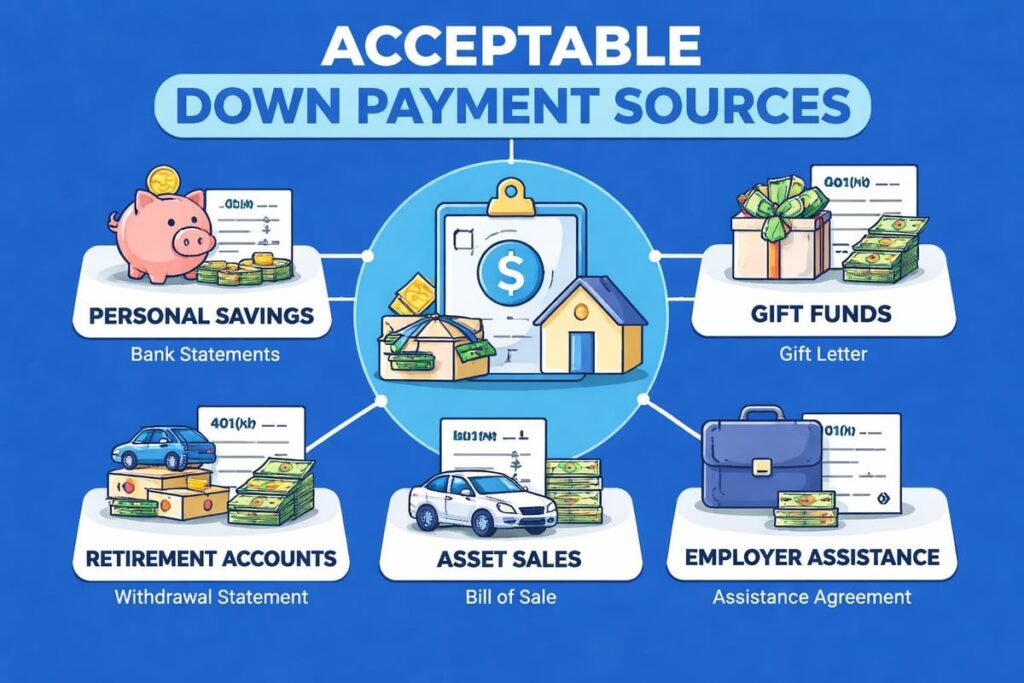
Buyers often ask what money can count toward a down payment beyond a savings account. The good news is that you have more options than most people think, as long as each one is documented the way underwriting expects.
Gift funds from family members are widely accepted on conventional, FHA, and VA loans with proper documentation. Donors must provide gift letters stating the funds are gifts, not loans requiring repayment. Bank statements showing the donor’s ability to provide the funds are typically required.
Retirement account withdrawals are permitted but carry tax implications and potential penalties. First-time buyers can withdraw up to $10,000 from IRAs penalty-free for home purchases, though income taxes may still apply. This is not tax advice, so talk to a tax professional before tapping retirement funds. 401(k) loans or hardship withdrawals are options but come with repayment obligations and risks if you change employment.
Sale of assets including stocks, bonds, or other investments provides legitimate down payment funds. Expect to document the sale transaction and transfer of proceeds into your bank account. Large deposits require explanation and sourcing during the mortgage approval process.
Grants from employers or relocation assistance for transferring employees can supplement your down payment. Tech companies throughout Seattle sometimes offer housing assistance packages for new hires or relocating staff, which can be combined with traditional financing.
What you cannot use: unsecured personal loans, cash advances from credit cards, or borrowed funds requiring repayment. These create additional debt obligations that impact your debt-to-income ratio and potentially disqualify you from mortgage approval.
Is a gift, RSU sale, or 401(k) part of your plan?
Each source has its own paper trail, and timing a large deposit wrong can slow an approval. I will walk you through exactly what to document, and when, before you move any money.
Ask Me First →Down Payment Timing and Market Considerations
Deciding when to buy based on your down payment readiness involves more than just hitting a savings target. Seattle’s real estate market experiences seasonal patterns, with spring and early summer bringing peak inventory and competition. Fall and winter often present opportunities for buyers with strong financial positions, including substantial down payments, to negotiate more effectively.
Interest rates also factor into your down payment strategy. Sometimes buying sooner with a smaller down payment makes more sense than waiting to save 20%, because prices and rates can move while you save. There is no universal answer, which is why I run both scenarios side by side before you decide.
Over long stretches, Seattle-area home values have generally risen, which is why some buyers choose to enter sooner with a smaller down payment and pay mortgage insurance for a few years. Appreciation is never guaranteed, and prices can flatten or dip, so this is a trade-off to weigh rather than a rule.
This doesn’t mean rushing into homeownership before you’re financially prepared. It means evaluating the complete picture: current rates, market appreciation trends, rental costs, and your personal financial stability.
Removing Mortgage Insurance After Purchase
For conventional loan borrowers who put down less than 20%, private mortgage insurance isn’t permanent. Once your loan balance reaches 80% of the original purchase price through regular payments, you can request PMI cancellation. At 78% loan-to-value, servicers are required to automatically remove it.
Many borrowers accelerate this timeline through home value appreciation. If your Seattle or Bellevue property increases significantly in value, you can request PMI removal based on a new appraisal showing 20% or more equity. Most lenders require:
- Minimum two years of on-time payments (some allow after one year)
- Current appraisal at borrower’s expense
- No subordinate liens on the property
- Demonstration of 20-25% equity based on current value
Alternatively, refinancing into a new loan without mortgage insurance becomes viable once you’ve built sufficient equity. This strategy works best when current interest rates are competitive with your existing rate, making the refinance cost-effective beyond just PMI elimination.
FHA mortgage insurance operates differently. For loans originated after June 2013 with less than 10% down, annual mortgage insurance premiums remain for the life of the loan. The only way to remove FHA insurance is refinancing into a conventional loan once you’ve reached 20% equity.
Tax Implications of Down Payment Size
The size of your down payment indirectly affects your tax situation through mortgage interest deductions. Larger down payments mean smaller loan amounts and therefore less mortgage interest paid annually. Since mortgage interest is tax-deductible up to certain limits, this reduces your potential tax benefit.
For 2026, you can deduct interest on up to $750,000 of mortgage debt ($375,000 if married filing separately). The standard deduction for married couples filing jointly is $32,200 in 2026, so many homeowners do not itemize, which makes the mortgage interest deduction less valuable than it once was. This is not tax advice, so talk to a tax professional about your situation.
This tax consideration shouldn’t drive your down payment decision but deserves acknowledgment in your overall financial planning. Buyers in higher tax brackets purchasing expensive properties in Bellevue or Kirkland may benefit more from mortgage interest deductions, making smaller down payments marginally more attractive from a tax efficiency standpoint.
Building Your Down Payment Savings Plan
Developing a realistic savings plan starts with knowing your target purchase price and required down payment percentage. For a $650,000 condo or townhome in Seattle (an illustrative example) with 5% down, you need $32,500 plus closing costs (typically 2% of purchase price), totaling approximately $40,000-45,000.
Automated transfers from every paycheck keep you on pace. For example, $500 per paycheck on a biweekly schedule adds up to about $13,000 a year. Keeping that money in a separate, insured savings account keeps it liquid and easy to document for your lender.
Reducing recurring expenses accelerates savings timelines significantly. Dining out, subscription services, and discretionary spending add up quickly. Redirecting $300-500 monthly from lifestyle expenses to your home fund can reduce your timeline by a full year or more.
For tech professionals earning equity compensation, RSU vesting schedules present strategic opportunities. Planning your home purchase around anticipated vesting events ensures maximum down payment capacity. However, timing market transactions around employment compensation requires careful tax planning, as RSU vesting creates taxable income events.
Whether you are ready to move with 3% down or building toward 20%, the right answer comes from your real numbers, not a rule of thumb. I am Keith Akada, a loan officer and branch manager at The Mortgage Reel, powered by Fairway Independent Mortgage Corporation, a direct lender. I help Seattle-area buyers, from first-timers to tech professionals with RSU income, compare down payment options, check assistance programs, and build a plan that fits both the purchase and the years after it. I do not sell, I educate.
Frequently Asked Questions
What are the benefits of a larger down payment?
A larger down payment can significantly reduce your monthly mortgage payments and eliminate private mortgage insurance (PMI), which is required for down payments under 20% on conventional loans. Additionally, it can strengthen your offer in competitive markets, as sellers often prefer buyers who can provide a substantial upfront investment. This can also lead to better loan terms and interest rates, ultimately saving you money over the life of the loan.
How can I save for a down payment effectively?
To save for a down payment effectively, start by setting a clear savings goal based on your target home price and desired down payment percentage. Automate your savings by setting up transfers from your checking account to a high-yield savings account. Additionally, consider reducing discretionary spending and redirecting those funds toward your home savings. Utilizing employer grants or assistance programs can also help bridge the gap between your savings and your down payment needs.
What are the tax implications of my down payment size?
The size of your down payment can affect your tax situation, particularly through mortgage interest deductions. A larger down payment results in a smaller loan amount, which means less mortgage interest paid annually. While mortgage interest is tax-deductible, many homeowners may not itemize deductions due to high standard deduction limits. Therefore, while tax implications should not dictate your down payment decision, they are an important consideration in your overall financial planning.
Can I use gift funds for my down payment?
Yes, you can use gift funds from family members for your down payment on conventional, FHA, and VA loans. However, proper documentation is required, including a gift letter stating that the funds are a gift and not a loan. Additionally, lenders may ask for bank statements from the donor to verify their ability to provide the funds. This option can be particularly helpful for first-time homebuyers who may struggle to save the full down payment amount.
What is the impact of market conditions on my down payment strategy?
Market conditions can significantly influence your down payment strategy. In competitive markets like Seattle, a larger down payment can strengthen your offer and make it more appealing to sellers. Conversely, during slower market periods, you may have more negotiating power and could consider a smaller down payment. Additionally, rising interest rates may prompt buyers to lock in financing sooner rather than waiting to save a larger down payment, as the cost of waiting could outweigh the benefits of a larger upfront investment.
What are down payment assistance programs available in Washington State?
Washington's main option is WSHFC's Home Advantage, which pairs its first mortgage with assistance of 3% to 5% of the loan at 0% interest, repaid when you sell, refinance, or pay off the loan. House Key Opportunity offers up to $15,000, the City of Seattle up to $76,000 for buyers under 80% of area median income, and county programs fill in elsewhere. Income limits, price caps, and homebuyer education apply.
How does my credit score affect my down payment options?
Your credit score plays a crucial role in determining your down payment options and mortgage terms. Higher credit scores can qualify you for lower down payment requirements on conventional loans, while lower scores may necessitate larger down payments, especially for FHA loans. For instance, FHA loans require a minimum of 3.5% down for scores above 580, but those with scores between 500-579 must put down at least 10%. Maintaining a good credit score can provide more flexibility and better rates when purchasing a home.
Related guides: 1st time home buyer programs in Seattle, conventional loans with 5% down, conventional down payment comparison, FHA home loans, and financing a home in Seattle.
How much do you really need down? Let's find out together.
I will compare every down payment option for your price range, check the assistance programs you may qualify for, and show your cash to close. No credit pull, no pressure.
Keith Akada, NMLS #112443, The Mortgage Reel
Call or text: (206) 601-3426
Email: keith@mortgagereel.com
Apply: Start Your Application